ELISABETH MOLIN’S LEGACY METRICS
In an interview with Elisabeth Molin she questions “staticness” and a space for gaps in generative AI.
By Monica Moran 7/6/2026
MM: You said you were really interested in Warhol's time capsules and how he thinks about time when we were talking about his diary. What specifically about time capsules interests you?
EM: Yes, I find it interesting that he works with time across different mediums, whether it is in the film Sleep (1964), the time capsules, or how he works with repetition through the screen prints that fade with each exposure. Also his use of scores and repetitions in the diaries and the transcribed conversations in e.g. From A to B & Back Again (1975). In terms of the time capsules, I can relate to this restless gathering of information, traces, snippets, and an attempt to create some kind of order, but at the same time, when you look at it, it's still very much about randomness and chance, and letting the information and the materials speak for themselves.
MM: Does this interest in time align with your interest in this "human made world"? As apposed to nature?
EM: In the series While we sleep sharks swim in between your ear and mine, I'm thinking about how entangled we are with the metals and materials around us, and how we share time with entities that are much older than us humans, like metals, glass, and copper. Also in how they have been processed and compressed, and how screens generally compress the perception of time. By combining them with other fragments from nature, I'm interested in bringing some kind of life back to these seemingly inanimate infrastructures.
MM: What's interesting about both subjects is that there's a type of mock biomechanics or growth within these found objects that are from old computer hardware?
EM: That is a funny observation. I like the idea of mock biomechanics. I suppose if the idea of biomechanics is finding patterns from nature and appropriating them for mechanical means, then perhaps what I'm trying to do is something opposite. Ezra Campelli, an artist I met while I was at ISCP, called these works ‘nature machines’, which I kind of like. Almost the idea of them having their own logic, their own function, although that function, whatever it may be or may have been, is something that is beyond me. I'm interested in how they branch out and become something else. When I'm assembling the works, I’m also often imagining them from the perspective of a future, and I see them almost as artifacts or archaeological objects that are reflecting on the now, which I think again relates to the time capsules.
MM: There's a recall in your work of the Saatchi collection for me personally because the YBA's were so prominent when I first came to New York. But in my opinion I don't believe that any of the work from the Saatchi collection was quite as literal about infrastructure. I think an artist would have to experience the world now in order to address some of your topics on infrastructure. Do you agree?
EM: Maybe we are living in a time where the infrastructures that are around us aren’t something we can take for granted in the same way the YBA’s could, or the conditions have shifted. I’m feeling, on one hand, a fragility of the systems and infrastructures around me, both in terms of ecological damage and because of wars. But also, at the same time, I don’t see infrastructures so often; they aren’t very visible to me, and that makes me curious about them.
MM: Can you talk more about grey zones and transit? You also mention. As opposed to static?
EM: In the context of these works, the grey zones and transit relate, on one hand, to infrastructures — all the invisible stuff that makes up our world. Both physical infrastructures, but also social and conditional ones. In a way, infrastructures facilitate all this movement, but they also allow us to assume a certain staticness. In general, I find it interesting with all the things we learn are static, e.g. that stones are static, and how language supports the idea that things around us are contained, as opposed to everything being porous and contingent upon one another.
MM: Which could also apply to your interest in dreams? I do think this show directly addresses that. This concept of artificial intelligence and artificial dreams. While we sleep sharks swim between your ear and mine. Does the title directly intersect with that statement?
EM: With the title I was thinking about something underwater, like an undercurrent, and how being underwater has a slightly surreal feeling to it, almost like losing gravity, which I think can be similar to the feeling of being submerged in, or looking at, a screen. Also, many of the elements in the works are found in the sea, or have been washed up on the shore, so it felt fitting.
To me, this porosity and melting with the screen can feel euphoric, and sometimes it makes me seasick. Sometimes it means I lose the ability to remember and distinguish where information came from, whether it is something I have seen or read somewhere, or something I dreamt. It is something Shoshana Zuboff describes beautifully in The Age of Surveillance Capitalism, how the screen became this perfect transient medium for information to pass through.
MM: Do you think art can serve as an intervention into that infrastructure or human made world? To apply a functionality or do you think art should just be? Or both?
EM: I think that art can reflect things and be like a mirror. Maybe the beauty of art is that it doesn’t need to be functional.
MM: In terms of generative AI, I don't know if that's something that interests you. But how history is presented on the Internet or social media is fundamental to generative AI. How do you think that relates to the Warhol time capsule?
EM: I think that's a very interesting question. If generative AI sources material from the internet, what about all the knowledge and voices that are not online? And who has built the engines that generate them in the first place? With the time capsules, what I find fascinating about them is that they are this arbitrary collection of information accumulated over the course of a day by one person, and that they speak about a particular time in history. I guess generative AI is attempting to transcend time and use all the fragments to create conclusions. I don’t know if there is space for gaps in generative AI.
MM: Is there anything that you wanted to discuss about the show that I didn’t ask?
EM: I can’t think of anything else.
MM: Thank you, Elisabeth Molin.
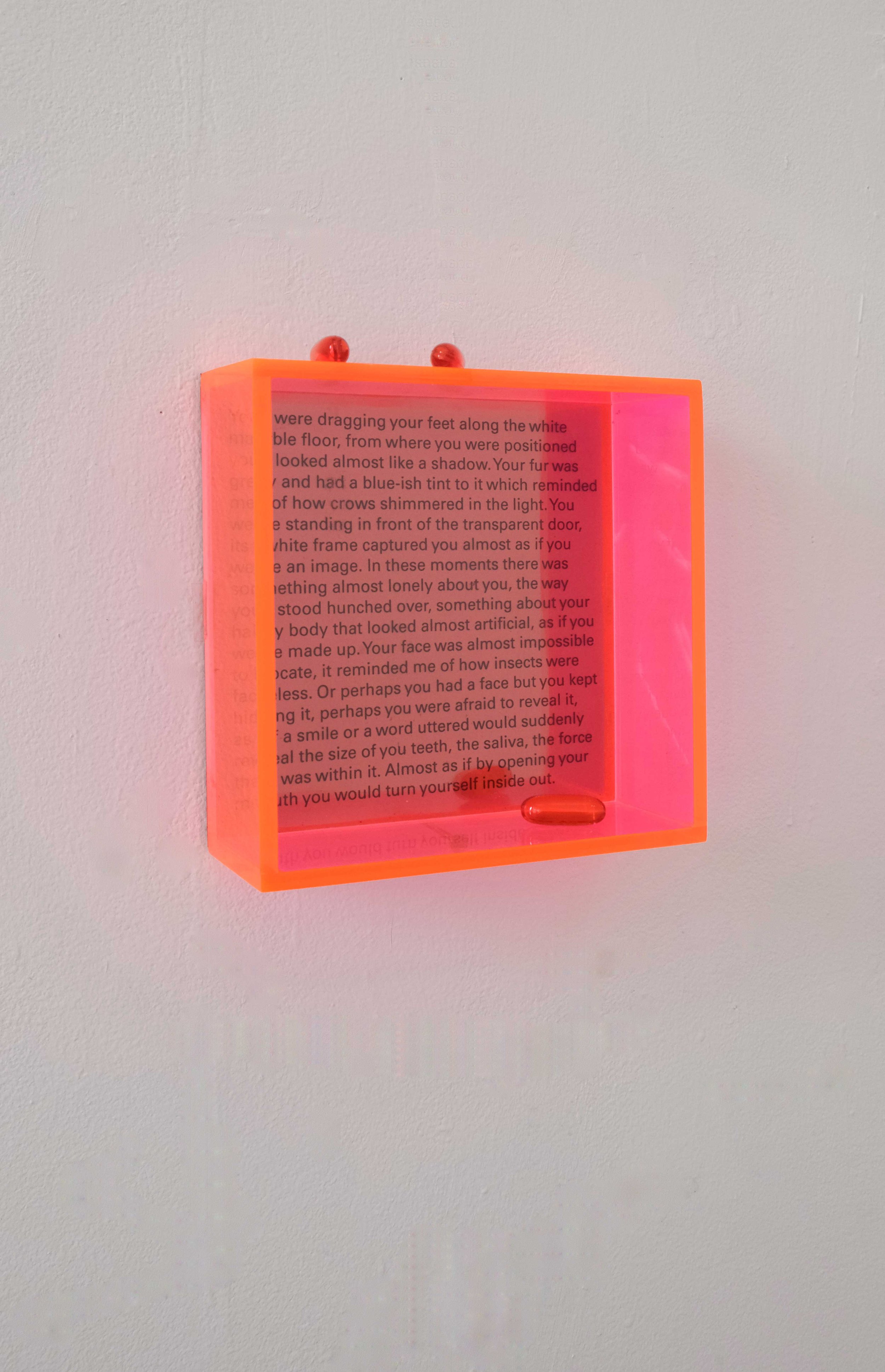
Move, string, wet (2026) by Elisabeth Molin