Invisible Infrastructures
Interview with Sean Wang
By Monica Moran
2/7/2026
MM: Where are these monuments located? Are they in Taiwan? Or are some in Hong Kong? Shanghai? Are they regional?
SW: These monuments are in Taiwan and Bulgaria. Both countries went through a shift from authoritarian rule to democracy, so it’s not surprising that people in both places have tried to damage or remove statues left over from those regimes. In this project, I overlay photographs of damaged statues from Taiwan with monuments from Bulgaria.
MM: I was talking to a journalist from Norway. I asked him what he thought about living in America. He said Americans were still very primitive and have a lot of weapons. Are your observations similar?
SW: My impression of the United States is that it has both an extremely brutal side and an extremely refined side—things like jazz, literature, and contemporary art. Of course, many countries have this kind of contradiction, but what feels specific about the U.S. is how closely these two sides coexist. They’re mixed together in a way that makes it hard to fully embrace the place, but also impossible to completely reject it.
MM: Do you perceive your photographs as representing the type of modernity that requires interaction? Or an intervention by something external?
SW: In the photographs, there is a sense of intervention, but without a visible agent. You don’t see a protester, you don’t see the action itself—only what’s left behind. That absence pushes the viewer to imagine what might have happened.
So the modernity I’m dealing with isn’t interactive in a literal or participatory way. It’s more contingent. Meaning only emerges when the viewer moves back and forth between different, and often incompatible, historical contexts. The work asks for mental engagement rather than physical interaction.
MM: The show as one single component, almost reads as a critique of the Western academy or Westernized knowledge. When juxtaposed to Taiwan I see it as colonization? Or an attempt to colonize an already advanced territory like Hong Kong. It makes me think of Amazon Web Services or Google colonizing London.
SW: I wouldn’t say the work is a critique of a specific institution. It’s more about questioning the assumption that ideas or frameworks—whether political, academic, or moral—can be smoothly transferred from one context to another.
When images connected to Taiwan’s transitional justice are placed onto Bulgarian monuments, it reflects how Western frameworks often circulate globally: they move easily, they carry authority, but they’re not always grounded in local realities. In that sense, the comparison to Amazon Web Services or Google makes sense—these are infrastructures that feel neutral or invisible, yet they quietly reshape local conditions.
MM: I’m reading Michael Sandel’s book, Justice: What’s the Right Thing to Do?. The book has been translated quite a few times. He’s a Harvard professor so it’s similar to that colonization discussion. It’s on the Barnes & Noble shelves. Kind of like an instruction manual for data centers, Amazon Web Services. Do you think your work addresses the idea of transposing these concepts of legal or even clinical environments? Some of the monuments look as though they have become patients in a hospital.
SW: Yes, I do think the work touches on how legal, moral, or even clinical frameworks are often treated as universal systems.
Visually, the monuments resemble medical records or forensic images—damaged bodies, exposed surfaces, a kind of clinical clarity. They start to look like patients being examined. For me, this reflects how societies increasingly manage history through technical or juridical language, as if political memory were something to be diagnosed and fixed, rather than argued over.
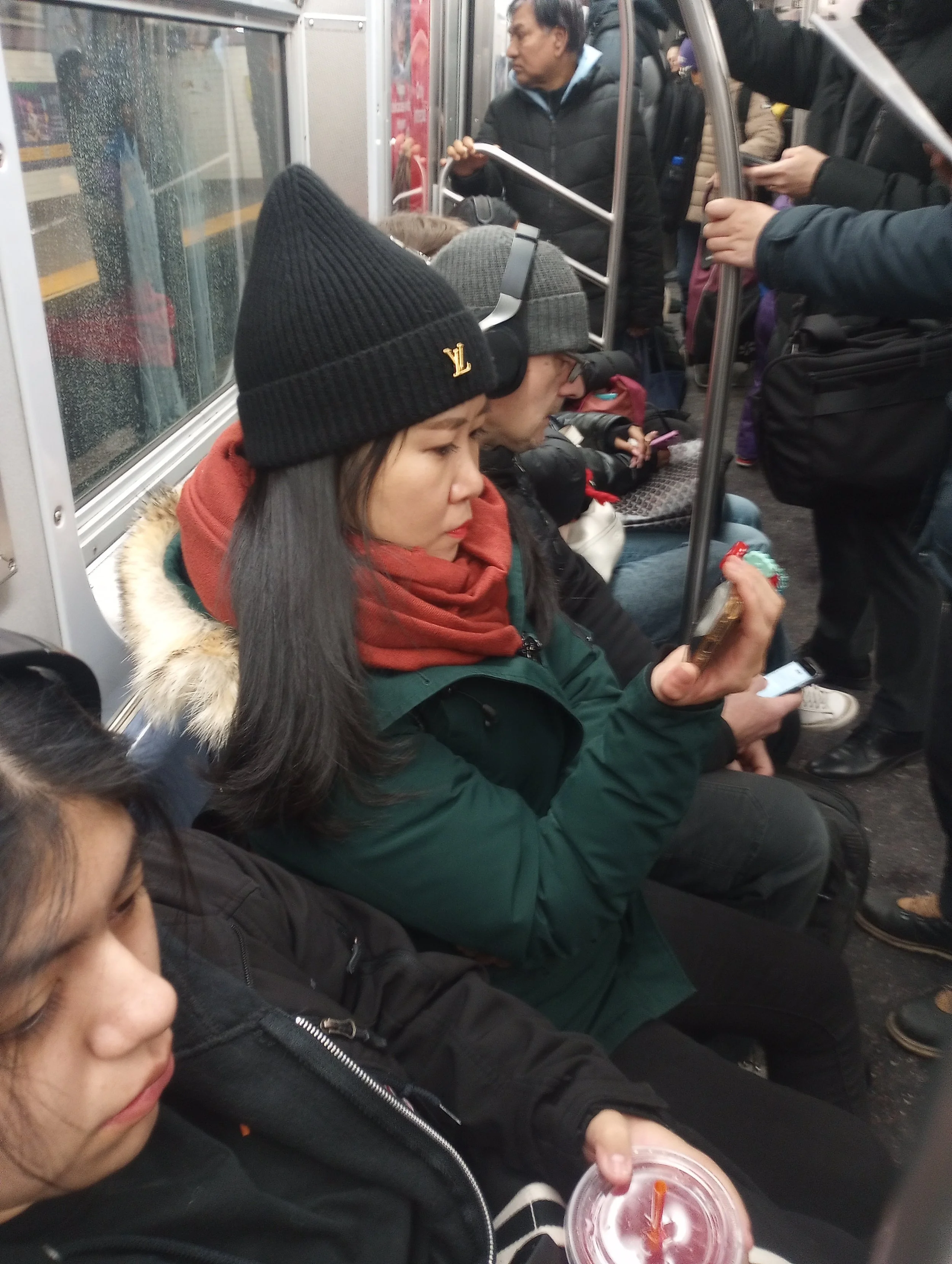
MM: Warhol had a way of integrating popular culture into these day-to-day coincidences that still seem to resonate today. I took this photo on the New York Subway this morning. The woman is wearing a YSL cap. Do you think the integration of the Diaries functions in a similar way? A critique of Westernized ideas. He spent a lot of time in Iran.
SW: When my work is shown alongside the Diaries, I feel a kind of everyday violence coming into focus. Just as statues are erected and later destroyed, Warhol’s references to bombs in his diaries don’t feel like they’re only about literal bombs. They point to the idea that violence is always present in daily life.
What interests me is that the work doesn’t give the viewer a clear position. We can’t easily support the ideologies behind the statues, but we also can’t simply celebrate the people who damage them. Instead, we step back.
This is where I feel a connection to Andy Warhol. When Warhol mimicked popular culture, he brought its mechanisms directly into everyday life—mass production, repetition, the factory model. These are core features of capitalism itself. By repeating those mechanisms rather than openly criticizing them, he created a kind of critique that doesn’t look like critique at first glance. I think my work shares something with that approach—a form of critique that operates by repetition and distance, rather than direct opposition.
MM: Thank you, Sean.