PAINTING BIG: Interview with Wendy Wei
4/26/2026
MM: Do you consider this collection of work a critical commentary or more poetic? One of your paintings is entitled Ozymandias. When I looked it up it was by an English poet.
WW: Yeah, I think it’s a mixture of both. The original poem is about finding the shattered ruins of a once-mighty king in a desert. It’s about the lost empire, the decay of power, pride, etc. But the painting features this kitschy trinket in a deserted bathroom. I like using irony in my titles. I think this painting is about loss and nostalgia, which is what I’ve been interested in exploring.
MM: Did you spend time in England? In Extraterrestrials, those are Teletubbies.
WW: Nope! It’s just that when I was little, my mom wanted an all-immersive environment for my English learning. So I ended up watching many cartoons from the West. For me, Teletubbies are foreign; they spoke English, and they were the extraterrestrials. But I guess the English learning part probably didn’t work, because there was barely any English in Teletubbies!
MM: How long have you been in New York?
WW: Almost two years.
MM: Aside from how beautifully they are painted, I think your paintings have tremendous potential on a larger scale due to the type of characterizations of your content. For instance the Sailor III painting. Was that your intent or were they simply a symptom of contemporary culture?
WW: Yes. Definitely. Absolutely. I think back in undergrad, in my tiny studio, I was grinding toward the biggest painting I could ever master (4 x 6 ft, which is big for me). I studied biology for a long time before switching to a studio art major. So I was at a phase where I felt the need to prove to myself that I was “good” enough to do art. In my small college in central Maine, I felt that if I didn’t go big, I would be buried in the middle of nowhere. Back then, painting big was almost acrobatic. It was about pushing for my extreme. It was about making myself seen.
But when I came to New York, nothing was big enough for New York, frankly. Just because it is big doesn’t mean it is good– It could just be a 4 x 6 ft giant slop.
My 4 x 6 ft painting from my undergrad thesis show now sits on the wall of my living room, covered in bubble wrap. I still think it’s a good one, it still has a special place in my heart. But I do not want to see it every day!
It’s like a spouse you have been with forever– you secretly hate and get annoyed by each other but you still love them (I have never been in a long-term relationship but somehow this might be my future, I reckon…).
In my MFA era in New York, because of the nature of being in an academic program, painting small is more economical for my growth, meaning that I could execute something in a relatively shorter span of time and get feedback immediately.
I could also actualize all of my ideas, whereas if I paint big, I might only get only one done. But I still have the desire to paint big. There is something so infectious, so youthful, so adventurous about making a large-scale painting. It also changes the relationship with the viewers as well. For me, painting big is like those shonen anime. You sign up for mistakes.
I found it hard to pull off a big painting, but it is a challenge I am willing to take on after graduation. I think to paint big is to blunder.
MM: Not to say they infantilize but that is the predominant aesthetic. Do you agree?
WW: Maybe, but I have never thought of this word before. I do like to paint childhood. I think I am caught up in the past that I could no longer return to, an era of a “golden” China.
I think my work is a little too tame to be infantilizing. But that could be my future direction. Maybe one day, when I get depressed, and I resort to full-on madness, who knows. Per my standard, Lisa Yuskavage’s work is infantilizing (in a successful way).
MM: Have you had any immersive or interactive side effects due to the nature of your characterizations? Like others who have seemingly assumed the identity of Sailor, or other phenomena associated with immersive narrative?
WW: I think so. People may look at Sailor and be like, oh Wendy is from Mainland China, so they view the graphic red sun as a “Red Star Over China” way, but that is never my intention.
However, I am open to all interpretations of my work. I never want to feed the audience my secondhand thoughts. That’s why I don’t like to get too descriptive when I talk about my work. There is no right or wrong. I find it beautiful that people have different things to say. I think the moment I give birth to my art, it’s no longer purely mine.
MM: I just got back from northern Nevada where I worked with a lot of artists from burning man and they really openly embraced this type of generative AI. I saw it as a type of recycling of the Seattle music scene. Only without the component of music. These big burning man monuments kind of filled the void.
Do you see that type of generative AI concept or application as a student of fine art in New York now? If so, is there a regional influence like Seattle or London?
WW: I do see some artist exploring the concepts of AI. Though they are mostly critical/cautious of the use of AI. At least in my department, there is one student’s entire work is about world-building this dystopia where AI reigns.
MM: Is there anything I left out or didn’t ask that you would like to add?
WW: Nothing to add I think.
MM: Thank you, Wendy.
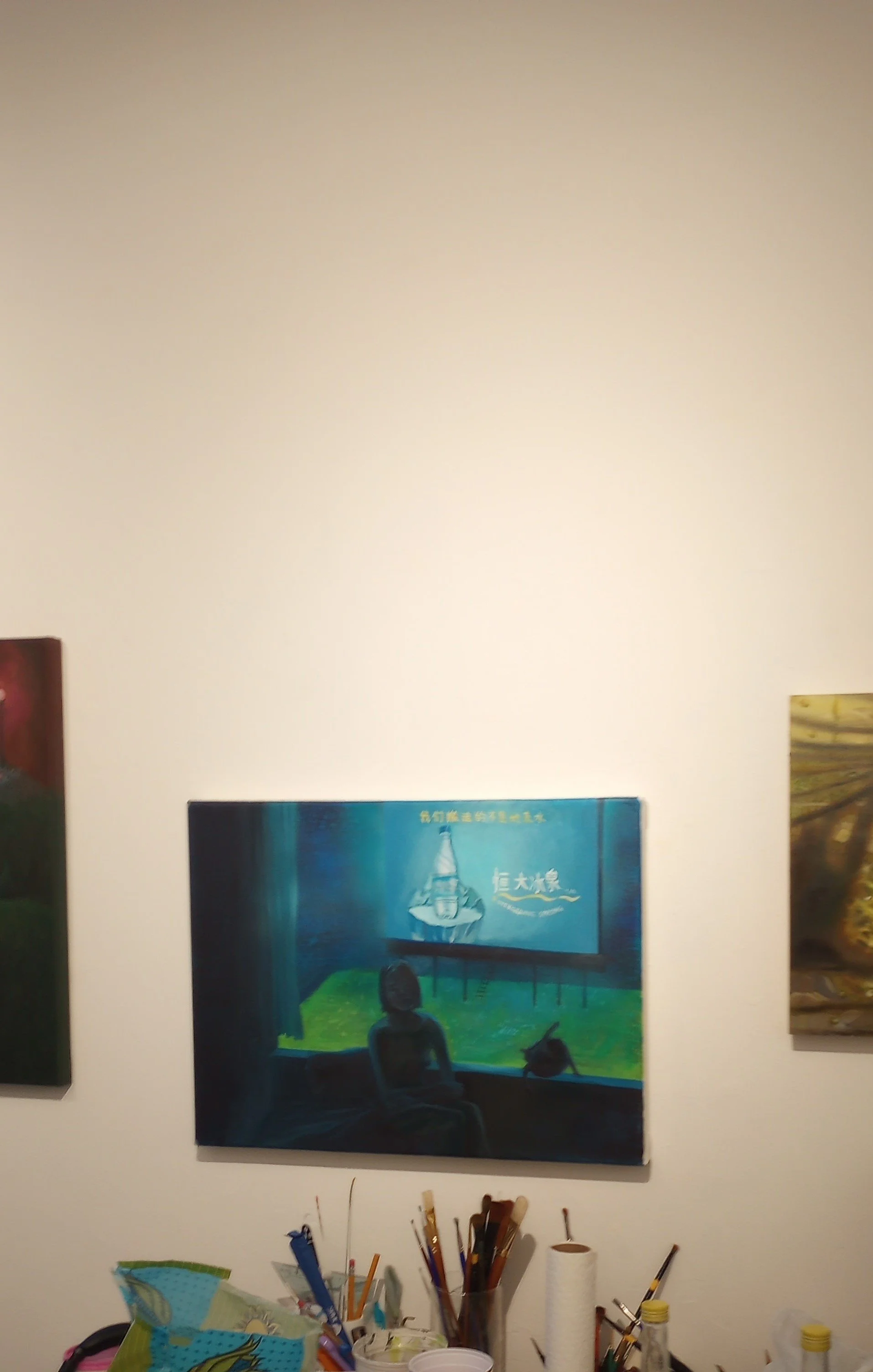
Evergrande in Wendy Wei’s studio, March 19, 2026.
Photo by Monica Moran